
A Billion Tokens Later: the aftermath and fear of AI class warfare
I spent 1.13 billion tokens in a month for $10.30. Almost all of it was context re-read from cache. What that counts, what it would cost elsewhere, and why the access question matters more than the energy one.
Confession
I’ve got another confession to make. I used a billion tokens this month. Well, actually 1.13 billion according to the dashboard, but let’s round down. What's a 100 million or so among friends, right? A billion is big enough to sound meaningless to most of us, and it’s easier to do the math with. And it’s not fictional either.

Before you pick up your torches and pitchforks, let’s maybe break down what this means first. We burn a lot of words arguing about the crazy numbers and almost none on who is allowed to do this in the first place.
Defining billions & tokens
Before the numbers get big, two words need unpacking: token, and billion. Neither means quite what you’d assume.
What is a token anyway?
When you feed text into a large language model, it needs to be written in a way the model understands. To do that your text is broken down into predefined chunks, which are turned into a number that tells the machine where to look up the information it has on the meaning of that token for example:
"Are you a teapot?"
[are][ ][you][ ][a][ ][tea][pot][?]
23, 3, 45, 3, 6, 3, 638, 2946, 74
For English text, one token is roughly 4 characters or 3/4ths of a word (1,000 tokens is about 750 words). Common words often equal one token, while rare or long words are split into multiple subwords. 1
Oh and there’s no one universal way of defining these tokens, so everyone pretty much has their own tokenizer making comparisons shown later on in this article more like guesstimates at best. But let’s move on to something more easily defined:
But what is a billion anyway?
Ah, finally some good old fashioned hard science to help us out in defining what is a billion.
A billion is a large number equal to one thousand million (1,000,000,000), i.e. one thousand million, or 10⁹, as defined on the short scale (also known as a milliard on the long scale). This is now the most common sense of the word in all varieties of English; it has long been established in American English and has since become common in Britain and other English-speaking countries as well.
The other sense is 1,000,000,000,000, i.e. one million million, or 10¹², as defined on the long scale (that is, a trillion in the short scale). This number is the historical sense of the word and remains the established sense of the word in other European languages. Though displaced by the short scale definition relatively early in US English, it remained the most common sense of the word in Britain until the 1950s and still remains in occasional use there.
Oh boy, that didn’t clear things up. Let’s uh, visualize it?
If a token is roughly 3/4 of a word, a billion tokens is about 750 million words. In physical form?
- Reading: 750 million words at 250 words per minute is about 5.7 years of non-stop reading. At a more human pace of one 300-page book a day (roughly 90k words), it’s about 23 years.
- Wikipedia: the English Wikipedia is roughly 4.4 billion words, so a billion tokens is about a sixth of it.
- Code: most of my tokens went to code. A modern car runs on somewhere around 100 million lines of code. At a rough eight to ten tokens a line, that is 800 million to a billion tokens: one car’s entire software stack, every line of it, fed through the model.
The amount of work
Making the model read the entire Twilight saga 1,250 times over for…fun? That sounds like a lot of work, and more importantly wasted energy.
Yeah, not gonna lie, spending a billion tokens in less than a month running task after task through coding harnesses across a pile of personal projects seems like a lot. Irresponsible even. Will no-one think of the water? Am I a boomer in a full AI craze not caring about the environment?
A billion tokens is not a billion tokens of thinking
An agent is stateless between calls, so on each turn it re-sends the whole conversation so far. My month was 4,551 calls. Of everything I sent, 99.75% was input and 0.25% was output, and of the input 99.03% came back from cache, so the model was re-reading a working memory it had already built across those projects and threads, not re-deriving them from scratch.
So the honest unit is not “a billion tokens of work”. It is “a thousand copies of the same context, plus a little new output each time”. That distinction is the difference between a scary number and a cheap one.
Guess first
Before we get to the numbers, two guesses. Commit before you read on.
- How many pots of coffee would you guess are baked into one of those 80s selfie filters?
- Is it greener to render an advertising-grade image in Blender, or to generate it with AI?
What it cost
Let’s start with how bad it could have been. If I had run this month on a frontier model, I would be writing this post to explain the invoice, not the tokens.
At published prices and cache rules, the replay lands at roughly $872 on Claude Fable 5.1, $1,702 on Claude Fable 5, and $2,277 on GPT-6 Astra. That is with the cache doing its job. Let the hit rate slip and the same month runs into five figures, towards $20,000! That is used-car money.
Then there is what I actually paid.
Why so cheap? It's not that DeepSeek is smarter. It really isn't, quite the opposite. But it is still smart enough. Real reason is simply about the price per token: output is priced at $50 per million tokens on the frontier versus well under a dollar here, and a cache read is a dollar or a quarter against about half a cent. My workload is almost all cache reads, so the multiplier lands exactly where I use the most tokens.
Why compare to Frontier models? To highlight the disparity. The same work, the same requests, the same context, and the same output more or less —yet the cost is two orders of magnitude different. And if cheaper models are going to be driven out of the market OR if you don't know what you're doing you could end up paying for "extra intelligence" you don't need.
Where these numbers come from
I replayed my actual request stream, all 4,551 calls, through each provider’s published prices and cache rules. Not a benchmark: my sessions. The hit rate comes out at 98.6%, so the cache window is not the problem. The price per token is. Drop the hit rate to zero and the frontier bill climbs towards $20,000 while mine stays in the low hundreds.
It is a replay, not an invoice. Re-tokenizing for each provider moves the result 10 to 20 percent either way, and it assumes append-only sessions, so an edit or a compaction breaks the cached prefix earlier than modelled.
Energy
I can account for every billed token but can't turn that into an electricity reading. Unfortunately for us, this sort of data is not readily available, so we'll have to settle for a modelled range of electricity consumption, not an actual measurement.
The closest published analogue is Zeke Häusfather’s own Claude Code analysis (The Climate Brink, August 2026). He logged 1,138 prompts, 14,000 model calls and 3.2 billion tokens over eight weeks, and three independent methods put it at 70 to 330 kWh.
Based on other research, info about the smaller open-weight model we can only narrow down that the usage somewhere between 25 to 117 kWh, while provider-published per-request figures for the DeepSeek family suggest only a few kWh. Due to this discrepancy, I will be using two values for my own usage: a low estimate of 2 kWh and a high estimate of 120 kWh. Had I used the Frontier models, the same work could have been far, far worse.
Here’s how that compares in practical terms.
Where the energy numbers come from
- My AI use (2 to 120 kWh). Modelled, not measured. Scaled from Häusfather’s 3.2-billion-token Claude Code run, where three methods land at 70 to 330 kWh, down to my volume and a smaller model, with provider-published per-request figures for the DeepSeek family at the low end.
- Fridge (45 kWh) and one EV charge (60 kWh). Round household figures, order of magnitude.
- My apartment (160 kWh). My own EnergiaOnline export, averaged over the last 12 full months. It runs on district heating, so this is lights and appliances only.
- House heating (830 kWh). Motiva’s example of a 120 m² electrically heated detached house puts heating alone at 9,500 kWh a year, out of 19,200 total, averaged to a month.
So the honest read is a range, not a measurement.
So either my use is negligible, or it is a small fraction of my apartment’s monthly electricity. Either way, it is a far cry of the amount of energy spent on heating up a house. Yet I am not hearing anyone trying to ban private homes in favor of apartment blocks.
What the published work does show is where the lever is. Google measures a median Gemini prompt at 0.24 Wh. Häusfather finds that agentic use is hundreds of times a chat prompt, that hardware efficiency gains have been eaten by Jevons Paradox, and that the choice that matters is the ecological impact of the electricity generation, not how many prompts any of us type.
So, how did you do?
Rough numbers, taken with salt. A pot of coffee (a litre, the kind a Moccamaster makes) is about 0.1 kWh, and one of those 80s selfie filters is a few thousandths of a kWh, so the filter costs less than a single pot. An AI image is about 3 Wh in the one study that measured it, with wide variation between models. Video is where it stops being small: 57.5 to 114.8 Wh for a standard five-second clip, and a model-specific estimate of 1,313 Wh for a twelve-second 1080p generation.
As you might be able to see, the image and the pot of coffee are within a couple of orders of magnitude yet the video generation breaks the pattern entirely.
What about Blender render?
A path-traced frame is just power times time. On your own machine that is a 300 W GPU grinding for ten minutes, about 50 Wh, or an hour for about 300 Wh. A production advertising still is heavier again: 4K to 8K, thousands of samples per pixel, eight to twenty minutes on a cloud node, which at roughly 700 W including data-centre overhead is 90 to 230 Wh for a single frame. Simple scenes render in under a minute.
An AI image on the other hand is only a couple of watt-hours a pass, so on paper AI wins by an order of magnitude.
But really, how many times have you gotten the AI image right on the first pass? Working this way is iterative by design: the prompt-refinement research (arXiv:2504.20340) assigns ten iterations per target image, and people who do this for a living describe many, many more. Thirty redraws is almost a short render; a hundred and you have long since passed any benefit. The AI image only looks cheap in comparison because the revision count is invisible. Not to mention the lack of control.
This is why I find it hard to have a solid, black-and-white opinion here. Perhaps the solution is somewhere in the middle, letting AI do final touches on a render or using more structured workflows and manual blocking/previz work to guide the AI.
Environmental impact
So yeah, none of this "work" is free. But this is where those damned data centers come into play. They can be magnitudes more energy efficient than your own setup, and cheaper too.
The problem lies in how some of them get their power. In Mississippi, xAI parked 27 gas turbines next to its Colossus 2 data center, with no permits, no public input, and no notice to the neighbourhood (SELC). Thermal drone footage shows them still running after the EPA reiterated that they need a permit. The permit application would allow more than 6 million tons of greenhouse gases and over 1,300 tons of health-harming pollutants a year, which would make it one of the largest fossil plants in the state (Guardian).

But that is a choice, not a law of physics. The same machines can feed an open district-heating network instead. Fortum’s network buys waste heat, and it already takes about 20 GWh a year from the Tiedon and Elisa data centers, roughly the annual heating for 1,000 detached houses (Fortum). Ericsson’s Kirkkonummi site sends in 10-15 GWh. Google’s Hamina data center, which used to dump its heat into the sea, now pipes it into the local network and covers around 80% of Hamina’s district heating, or roughly 2,000 homes (Yle).
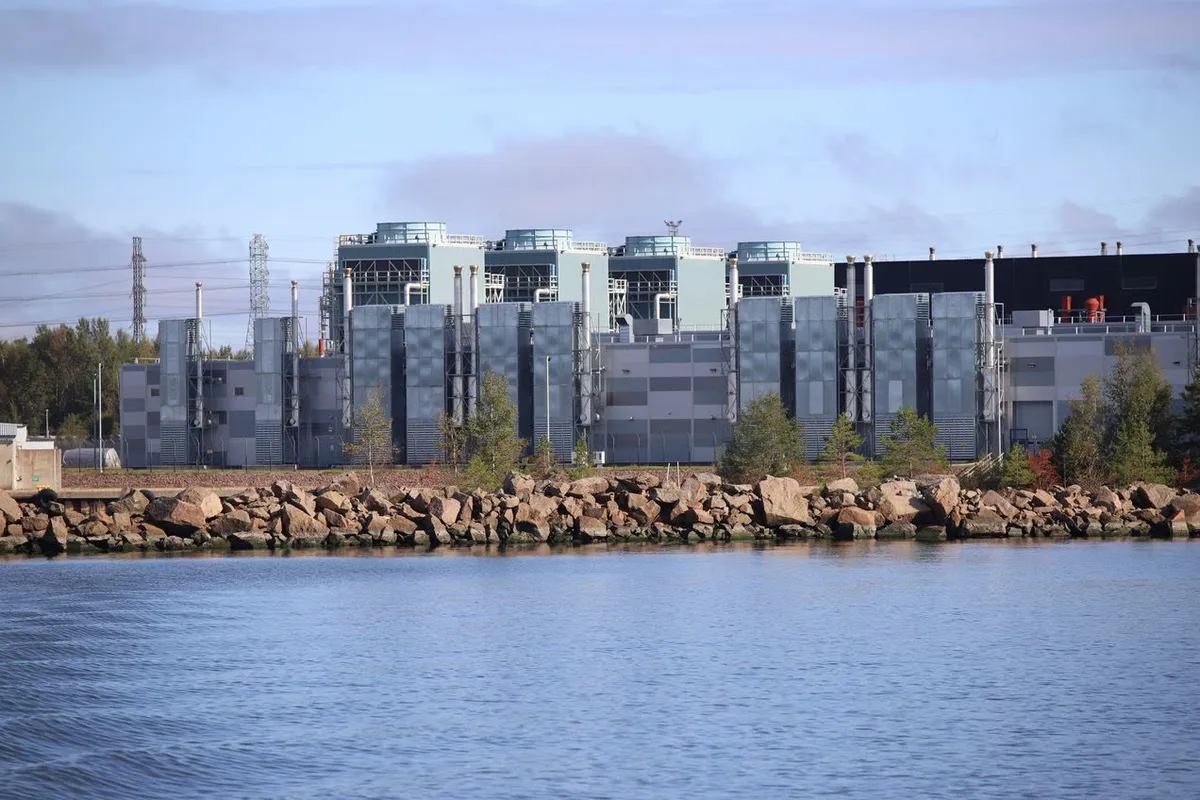
These are examples of what is possible, not proof that data centers are benign. The point is that the harm is a matter of how the power is sourced and whether the heat is captured, not a law of nature. Air & noise pollution laws already cover most of it, if anyone applies them.
The actual anxiety
The thing that makes my setup possible, and the thing under threat, is open weights. There’s a real argument against them: models do carry bias, they can be pointed at malware and they can be altered to do things they weren't intended for. Once the weights are out you cannot take them back either.
That worry is legitimate. The UK’s AI Security Institute measures leading open models trailing the closed cyber frontier by four to seven months, and points out that once weights ship, safeguards can be stripped and copies run beyond any monitoring. This risk doesn’t evaporate because the people voicing it also happen to stand to profit.
What I don’t buy is the "fix". The big players are pushing for rules that would make open weights illegal, unprofitable and at the very least slow down their development.
Well meaning laws try to either curb AI training, AIs from outside their sphere of influence (the EU AI Act presumes systemic risk above 10^25 FLOP; the old US order used 10^26) or set other requirements which in practice means companies that already have lawyers and compliance budgets stand to gain. The door closes behind the incumbents, and renting becomes the only option. That’s not safety. It’s a moat with a nicer name.

You can watch it happen. In July, Nvidia and a couple of hundred companies signed an open-weights letter, and Anthropic was the one major lab that didn’t. It published its own position instead: no ban, just chip export controls, a crackdown on distillation, and mandatory pre-release testing for every sufficiently capable model. Those asks don’t say “ban,” but they land close enough, and they suit anyone selling closed frontier access.
OpenAI signed the letter, and it would be a mistake to read that as principle. It’s reportedly lobbying the other way alongside Anthropic in Washington, and it has pushed for federal rules that apply only to the top-tier labs, explicitly excluding startups and open weights. Both companies sell the same thing, and a rule that lands on the frontier, or on anyone who ships weights, clears the field of everyone smaller. Nobody in this fight is the good guy.
The US even scrapped its own AI safety order in 2025 the moment it became inconvenient, while officials now weigh banning Chinese open models outright. That should tell you how much of this is about safety and how much is leverage.
Not the energy, not the data centres but that concentration of power and control is the actual source for my anxiety. The rich run models at full power and keep the returns, while everyone else either chinamaxxes on soon-to-be-illegal open weights or pays through the nose for a drip-feed, and the gap just widens. Meanwhile the same labs warning that Chinese models phone home ship assistants that keep your prompts and, by default, train on them. The concern stays remarkably selective about which direction the data flows.
Argue about the right thing
The discussion around AI is so loaded that we mostly talk past each other. On one side, the black-and-white yet well-meaning anti-AI folk armed with…misinformation. On the other, the zealous AI-enthusiasts with orchestrator agents running other agents 24/7, never stopping to think if all that “work” is necessary. We use it so differently that we only ever see fractions of it. Some do everything with LLMs, others barely touch them. Perhaps both should think: "Should I be using AI for this?".
Most of the shouting is aimed at the wrong target, and it is aimed with bad numbers. The energy conversation runs on per-prompt figures that do not measure what they claim, for a unit that stopped describing how these tools are used the moment agents arrived. The access conversation barely runs at all, and it is the one that decides who can still do this work next year. Häusfather puts it better than I can: the behind-the-meter choice between gas turbines and clean power will matter far more than how many prompts any of us type.
I can run a billion tokens from my sofa for Pepsi Max money (thanks, inflation!). The same work on a frontier model is one to two thousand dollars, and more if the cache is less forgiving. Token volume has grown roughly 17,000x in four years as prices fell, and who gets to keep them falling is the whole fight.
So that’s the ask. Do the maths first, get the scale right, then pick your fight. I’m not saying AI is fine or AI is doom. I’m saying the fight worth having is about access and control. It's about who gets to write the rules.